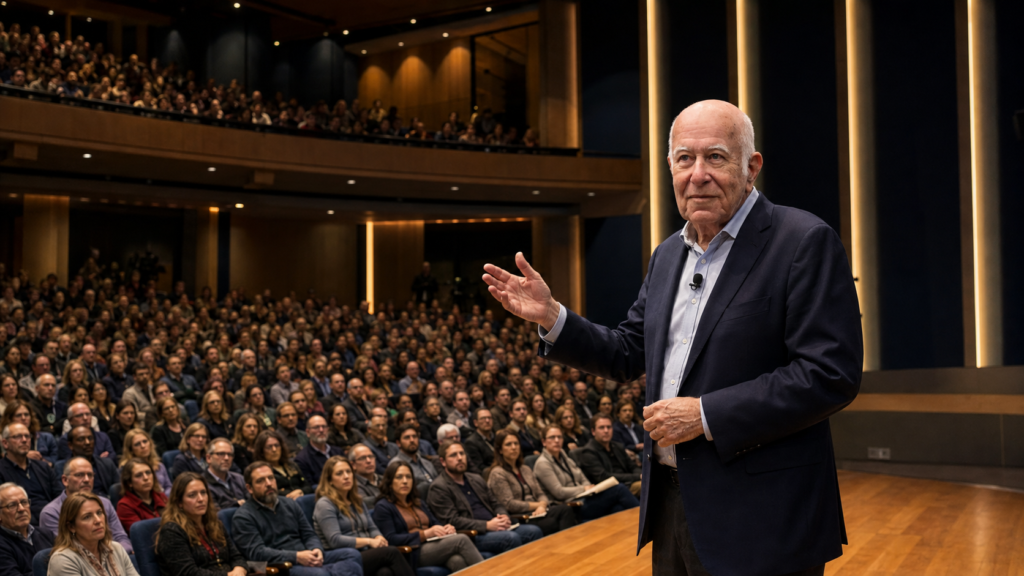
Workshops & Lectures
Books are where I write the ideas.
I have always loved learning. I have loved watching people learn even more.
Why I Still Do This
People rarely change because they received more information.
They change when an idea makes them see something differently. Fifty years of teaching taught me that, and no textbook could have.
For decades I taught university courses, led workshops, worked with organizations, and mentored executives and chief executives — in classrooms and meeting rooms, with people from very different countries and cultures.
These days most of my time goes to writing, capturing what those decades taught me. Those experiences live inside my books.
A question from the audience. A disagreement. A story someone has never told before. The moment a person recognizes his own behavior in what we are discussing and goes quiet.
None of that happens on a page.
What I Speak About
Five questions, and the behavior underneath each one.
Every talk is built around a question the audience has already asked themselves. Each one can stand alone, or be combined into a longer session.
Why do intelligent people sell at the bottom?
You cannot control the market. You can control your behavior. One system, one method, and the discipline that separates the investors who keep their gains from the investors who give them all back.
Are they really your friends?
Words are easy. Actions reveal the truth. Six qualities decide who stays when it costs them something — and how to tell the difference before the crisis, not during it.
Nobody believes they are the unkind one.
The distance between how you are received and who you actually are. Politeness manages appearances. Kindness is willing to be briefly uncomfortable in order to be useful.
Four words do most of the damage.
But, always, never, and just. How the sentences you use shape what you notice, what you avoid, and what you eventually do.
Where did the years go?
Time cannot be managed. What you manage is your behavior. Why decades compress, and the ten disciplined habits that leave something behind.
Discipline beats intelligence.
Why success in a company, a classroom, or a portfolio is rarely a matter of intelligence — and what leaders can actually build instead.
Formats
Shaped to the room, not to a slide deck.
Forty-five to sixty minutes on one question, with time for the audience afterwards. The questions are the part that matters.
One subject, worked through with the tools from the book — the assessments, the diagnostics, and the exercises people actually complete in the room.
A small group, a closed room, and the conversations that do not happen when the audience is large.
In English or in Hebrew. Both are native to me, and the material exists in both.
Based between Israel and Spain, and available for travel.
Before You Invite Me
This is not for every room.
Invite me if
- You want your people to leave thinking differently, not just knowing more.
- You are willing to let the audience talk back.
- The subject matters more to you than the entertainment.
- You would rather have one honest hour than three polished ones.
Do not invite me if
- You want a motivational speaker.
- You want market forecasts or stock recommendations.
- You need the message softened so nobody is uncomfortable.
- You want a talk that could be given by anyone.
Nobody needs another lecture that leaves them knowing more.
You already know more than you practice. The question is what you will do differently.
Invite Dr. Cohen to SpeakDoctor of Education, Vanderbilt University, George Peabody College · M.Sc. Organizational Behavior, Tel Aviv University · B.Sc. Behavioral Sciences, Ben-Gurion University · Fifty years in markets, organizations, and classrooms